Cyber Security and Data Protection
Strong cybersecurity practices help protect sensitive immigration, business, and personal information in an increasingly digital environment.
29/09/2026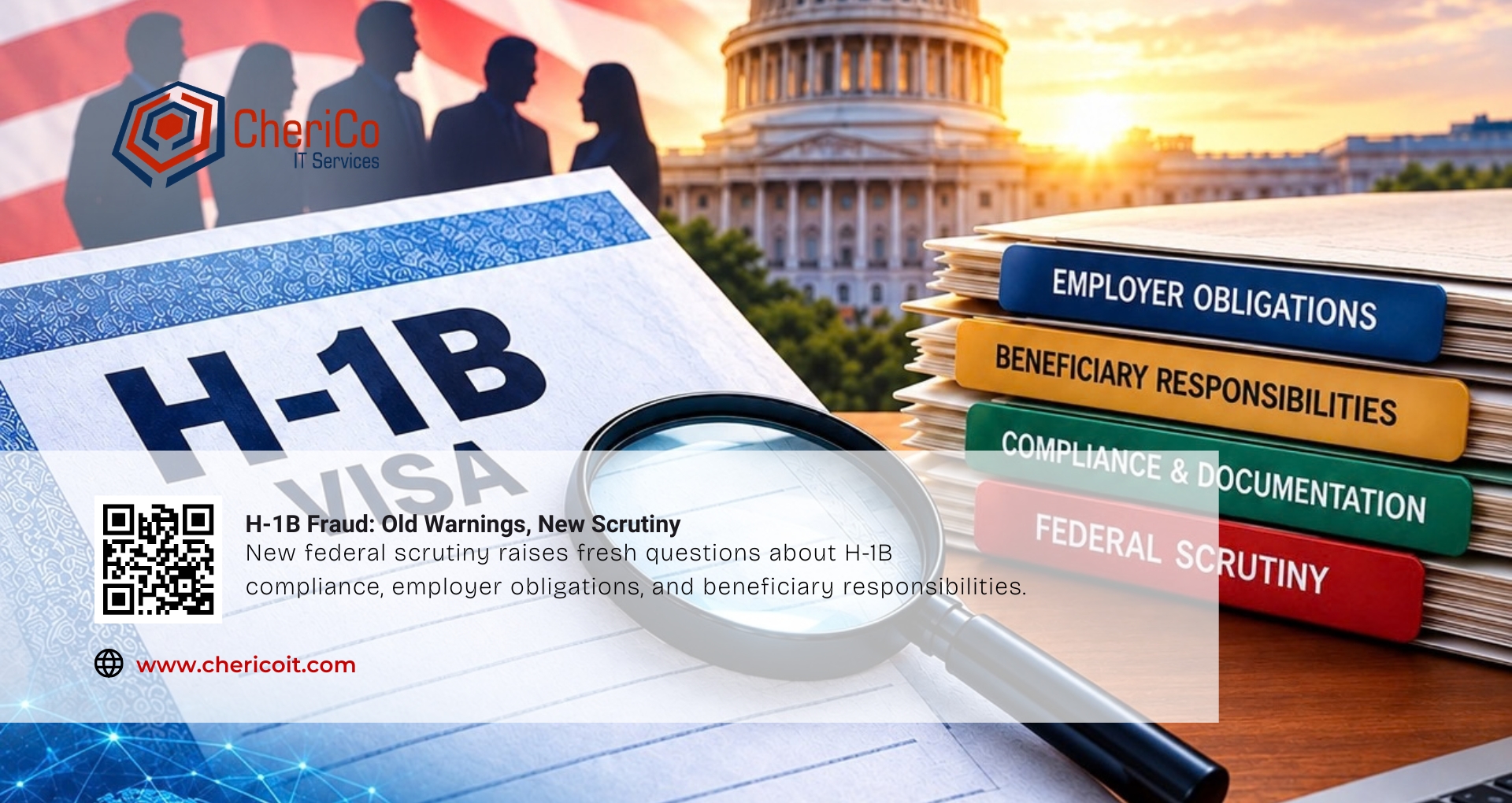
A former U.S. consular officer’s account has resurfaced amid intensified federal scrutiny of the H-1B program. Mahvash Siddiqui, who served with the U.S. Department of State, has described concerns she says she encountered during visa adjudication, including questionable credentials, employment documentation, and recruitment practices. Her account is a personal recollection, not a government finding against any particular employer. However, government records provide relevant historical context: a 2002 (GAO) report documented fraud concerns involving immigration benefits and the challenges federal agencies faced in detecting and addressing such cases. Together, these accounts help explain why representations made by employers, recruiters, and beneficiaries may receive close scrutiny.
That historical context has taken on new significance in 2026. On September 18, 2026, the U.S. President signed an Executive Order directing the Departments of State, Labor, and Homeland Security to consider whether an H-1B sponsoring employer recently laid off, or plans to lay off, similarly situated U.S. workers when reviewing H-1B petitions, visa applications, requests for admission, and Labor Condition Applications (LCAs). The Order also calls for consideration of broader federal economic and labor-market data. Separately, the Department of Labor’s Office of Inspector General states that it is investigating alleged fraud and exploitation involving the H-1B and PERM programs. The OIG announced that new PERM labor certification filings by Cognizant and Cloudera were suspended pending the investigation. These actions signal heightened federal scrutiny of the information and circumstances underlying employment-based immigration filings.
For immigration counsel and corporate sponsors, the current environment makes accuracy and supporting documentation increasingly important. Employers should be able to substantiate job duties, worksite details, wages, beneficiary qualifications, and the involvement of recruiters or third-party staffing arrangements. Beneficiaries should understand the material information submitted on their behalf and retain accurate records of their education, employment, and immigration history. USCIS, DOL, DHS, and the Department of State each have distinct roles in the immigration process, and applicable requirements may vary by filing and visa category. Individuals who may be affected by these changes should carefully review USCIS guidance and filing requirements.
This information is provided for general educational purposes and does not constitute legal advice.
Explore more:
Enhancing Program Integrity….H-1B Nonimmigrant Visa Program | The White House
Fact Sheet: Program Integrity…H-1B Visa Program – The White House
Strong cybersecurity practices help protect sensitive immigration, business, and personal information in an increasingly digital environment.
29/09/2026
New federal scrutiny raises fresh questions about H-1B compliance, employer obligations, and beneficiary responsibilities.
22/09/2026
DHS has broadened permanent residence eligibility for certain U.S.-born children of foreign government employees.
15/09/2026